I don't much celebrate birthdays — do you? — but I don't think I'd even consider celebrating my birthday while alone, and if I did, I might come up with the idea of champagne and some special food, but not of picking up a musical instrument and serenading myself.
It's so charming — don't you think? — that mandolin, foie gras, and champagne. I look to see — when was his birthday? Did he get to that birthday before the deathday popped up in the timeline of fate? Yes, he did. His birthday was January 14th. He died on the 21st.
"But through relentless touring and a 1978 appearance on NBC’s 'Saturday Night Live,' Meat Loaf found an audience, making 'Bat Out of Hell' an enormous, if unexpected hit.... Its signature tune, 'Paradise by the Dashboard Light'... was an ornate melodrama about a teenage make-out session... more than eight minutes long and [it] even contained a long segment narrated by Hall of Fame baseball player and broadcaster Phil Rizzuto, describing a batter rounding the bases and sliding into home. (Rizzuto said he didn’t realize his description was meant to be an elaborate sexual metaphor.) His musical secret, Meat Loaf said, was that he approached every song like an actor preparing for a role. 'I can’t sing unless there’s a character... Because I don’t sing. It’s almost like being schizophrenic — I don’t sing, the character sings.' Early in his career, the long-haired, 300-pound Meat Loaf was openly mocked by critics — and even by [his collaborator Jim] Steinman, who once called him 'a grotesque, bloated creature, who stalked the stage like an animal but acted as if he were a prince.'"
This wasn't my kind of music, but I can admire his work from afar. People loved him in "The Rocky Horror Show,” and he had a very interesting role in "Fight Club."
And he's got a great Donald Trump connection — "Meat Loaf, should I run for President?"
Later, "You look in my eyes: I am the last person in the fucking world you EVER want to fuck with":
The history of polka dots. This is the article I want to read. I feel some pressure to write about Biden's 2-hour news conference yesterday, which I watched, but I'm loath to blog it without a complete transcript. I have seen the "5 takeaways" pieces and the "utter disaster!!!" stuff, and it's propaganda on top of propaganda. Until I find a transcript, I'm holding off, I'm in the ellipsis... and therefore: polka dots!
Haramis writes delightfully:
Though a staple of Central European folk art, and named for a dance popularized in mid-19th-century Bohemia (now part of the Czech Republic), polka dots have played an outsize role in defining America’s national identity over the past century. For a country constitutionally preoccupied with happiness, the print has proved a useful and recurring signifier of optimism, especially when it seems furthest from reach. Polka dots are the uniform of the ever-perky Minnie Mouse, and of a relentlessly high-spirited Shirley Temple in 1934’s “Stand Up and Cheer!,” released in the midst of the Great Depression. During World War II, when Westinghouse Electric produced a poster to boost the morale of female workers, it depicted a factory employee with her hair wrapped in a red polka-dot scarf, ready to get the job done. (The refined New Look — rounded shoulders, cinched waist, billowing skirt — that Christian Dior developed in the postwar years was in many ways an expression of European distaste for Rosie the Riveter’s earnest vigor.) By the 1950s, polka dots had come to symbolize, for better or worse, the dogged cheer of midcentury America. Marilyn Monroe and Lucille Ball wore the print with such frequency that it became the visual equivalent of apple pie — comforting but predictable — and in Billy Wilder’s 1961 political satire, “One, Two, Three,” East German Stasi officers torment a suspected spy by playing, on repeat, a caterwauling version of the 1960 Brian Hyland song “Itsy Bitsy Teenie Weenie Yellow Polkadot Bikini.” Too much of a good thing can be wonderful; it can also be torture.
Ha ha. I remember when that song came out. There were so many novelty songs at the time, and they were wonderful to me when I was 9. As for bikinis, though they were very controversial until the 1970s, they'd been around since 1946, when the designer named them after the atomic bomb test that had just taken place on the Bikini Atoll. And that drags me back into contemplating Biden's new conference, in which I believe he advised Putin that the only way for him to succeed in Ukraine would be to use nuclear weapons. I need the transcript....
Here's the Wikipedia article on polka dots, where, among other things, I learned about Polka Dot Man and the fact that because the dots on his costume are different sizes and colors, they are not actual polka dots:
Apparently, Polka Dot Man can peel off those dots and turn them into useful weaponry. He looks a little like Biden, don't you think? That smile! Those eyes... speaking of dots....
ADDED: 2 years before "Itsy Bitsy Teenie Weenie Yellow Polkadot Bikini," there was that other novelty song about skimpy clothing for women, "Short Shorts." On the piano, that's Bob Gaudio, who co-wrote the song and went on to co-write all the most famous Four Seasons songs:
And as long as I'm extending this post with extra video of songs about wild things women are wearing, here's the most famous number from "The Gang's All Here," "The Lady In The Tutti Frutti Hat":
That moved the classy critic James Agee to write: "There is one routine with giant papier-mache bananas, cutting to thighs, then feet, then rows of toes, which deserves to survive in every casebook of blatant film surreptition for the next century." And here we are in the next century, talking about it.
AND: From the OED entry for "polka dot":
1966 Mrs. L. B. JohnsonWhite House Diary3 Apr. (1970) 382 A young newspaper-woman in a black-and-whitepolka-dotbikini, with a figure to suit it....
1957 V. NabokovPninvi. 138 Amber-brown Monarch butterflies flapped.., their incompletely retracted black legs hanging rather low beneath theirpolka-dottedbodies.
1996 EsquireJune 38 A model whosenom de spumewas Big Ginger bobbed her lush mangoes perkily against herpolka-dottedbikini top.
"According to MRC Data, old songs now represent 70% of the US music market.... The new music market is actually shrinking.... [T]he 200 most popular tracks now account for less than 5% of total streams. It was twice that rate just three years ago.... [T]he current list of most downloaded tracks on iTunes is filled with the names of bands from the last century, such as Creedence Clearwater and The Police. I saw it myself last week at a retail store, where the youngster at the cash register was singing along with Sting on 'Message in a Bottle' (a hit from 1979) as it blasted on the radio. A few days earlier, I had a similar experience at a local diner, where the entire staff was under thirty but every song more than forty years old. I asked my server: 'Why are you playing this old music?'
She looked at me in surprise before answering: 'Oh, I like these songs.'... The people running the music industry have lost confidence in new music. They won’t admit it publicly.... The moguls have lost their faith in the redemptive and life-changing power of new music—how sad is that?... [And yet m]usic company execs in 1955 had no idea that rock ‘n’ roll would soon sweep away everything in its wake. When Elvis took over the culture—coming from the poorest state in the US, lowly Mississippi—they were more shocked than anybody. And it happened again the following decade, with the arrival of the British Invasion from lowly Liverpool (again a working class city, unnoticed by the entertainment industry). And it took place again when hip-hop emerged from the Bronx and South Central and other impoverished neighborhoods, a true grass roots movement...."
I was listening to Bob Dylan's old radio show — "Theme Time" — the other day, and he read what was supposedly a letter from a listener, asking why did he play so much old music when there's new music too. His answer was: He plays old music because there's so much more of it.
The old should dominate. There's a century and more of old recordings to play on the streaming services. Why should the music of the last few months predominate? Anything new has to compete with everything old.
I'm old, so I don't expect to like anything new, and I'm delighted to have access to the entire history of recorded music with Spotify. I discover things that are new to me. Some of them are many decades old, sometimes even older than I am, and, as I said, I am old. These are recordings, not live concerts. They're like books. We pick what's best, not what's new.
But I remember how exciting it was, back in the 1950s and 60s, to hear what was new on the radio, to feel that the culture was alive and inventive and a cool, unfolding surprise. Maybe none of that would have happened if we'd had something like Spotify/Apple Music to allow us to root around endlessly in the past.
"According to MRC Data, old songs now represent 70% of the US music market.... The new music market is actually shrinking.... [T]he 200 most popular tracks now account for less than 5% of total streams. It was twice that rate just three years ago.... [T]he current list of most downloaded tracks on iTunes is filled with the names of bands from the last century, such as Creedence Clearwater and The Police. I saw it myself last week at a retail store, where the youngster at the cash register was singing along with Sting on 'Message in a Bottle' (a hit from 1979) as it blasted on the radio. A few days earlier, I had a similar experience at a local diner, where the entire staff was under thirty but every song more than forty years old. I asked my server: 'Why are you playing this old music?'
She looked at me in surprise before answering: 'Oh, I like these songs.'... The people running the music industry have lost confidence in new music. They won’t admit it publicly.... The moguls have lost their faith in the redemptive and life-changing power of new music—how sad is that?... [And yet m]usic company execs in 1955 had no idea that rock ‘n’ roll would soon sweep away everything in its wake. When Elvis took over the culture—coming from the poorest state in the US, lowly Mississippi—they were more shocked than anybody. And it happened again the following decade, with the arrival of the British Invasion from lowly Liverpool (again a working class city, unnoticed by the entertainment industry). And it took place again when hip-hop emerged from the Bronx and South Central and other impoverished neighborhoods, a true grass roots movement...."
I was listening to Bob Dylan's old radio show — "Theme Time" — the other day, and he read what was supposedly a letter from a listener, asking why did he play so much old music when there's new music too. His answer was: He plays old music because there's so much more of it.
“She will have her own place in history because there was nobody like her,” Darlene Love, who also worked with Spector in the early days, tells Rolling Stone. “When I first met her in 1964, she was this little bitty thing — she reminded me of a little Barbie doll. But then she had this big voice. The way she sang and moved onstage, that was rock & roll.”...
“As I said many times while he was alive, he was a brilliant producer, but a lousy husband,” [Ronnie Spector] said shortly after [Phil Spector] died last year. “Unfortunately, Phil was not able to live and function outside of the recording studio. Darkness set in, many lives were damaged. I still smile whenever I hear the music we made together, and always will. The music will be forever.”
"... died on Saturday at her home in Los Angeles. She was 93. A spokesman, Ken Sunshine, said the cause was respiratory failure.... For many years their words were also heard every week over the opening credits to hit television shows like 'Maude,' 'Good Times' and 'Alice.'.... In 1956 she fell down a flight of stairs and broke her shoulder.... Unable to play the piano because of her injury, she recalled many years later, she could not compose and so decided to write lyrics instead."
The most familiar one to me is this — on the first 4 Seasons album. Much as I've loved the 4 Seasons in my time, I've got to promote the Billy and Lillie version from 1958:
This is a silly song, with lyrics that include: "La dee dah, oh boy/Let's go/Cha, cha, cha/I feel so fine/Now that you are mine...." Excellent candy.
I'm not sure if I remember the Ringo song "La De Da" — spelled like that. This is from 1998, from his 11th album:
This too is pretty silly, with lyrics like "La la de da, like que sera sera/Whatever la de da, la de da/All you got to say is la de da." Okay. Ringo. It's Ringo. What can you say? It's easiest to quietly love him.
Then there's a Foo Fighters song from 2017. The spelling here spelled "La Dee Da." This lacks the la-dee-dah feeling of Billy and Lillie and Ringo, with lyrics like: "Hate if I want to, hate/Psychic Television and Death in June/Jim Jones painting in a blue bedroom." Listen to it here if you like. Whatever their problem is. I choose to pass that one by.
But the really striking la-dee-dah song is "Lah-Di-Dah" — and let me say, that's my favorite spelling — by this English guy Jake Thackray, whom I had never heard of:
I hope you made it past his long introduction! Wikipedia says: "John Philip "Jake" Thackray (27 February 1938 – 24 December 2002) was an English singer-songwriter, poet and journalist. Best known in the late 1960s and early 1970s for his topical comedy songs performed on British television, his work ranged from satirical to bawdy to sentimental to pastoral, with a strong emphasis on storytelling, making him difficult to categorise."
This "Lah-Di-Dah" is an elaborately written song about loving a woman enough to put up with her awful family. The lyrics include:
I'll be nice to your mother I'll come all over lah-di-dah Although she always gets up me nose I love you very much And so I'll smile and I'll acquiesce When she invites me to caress Her scabby cat I'll sit still while she knits And witters, cross my heart And I shan't lay a finger on the crabby old batface
That's one of 5 verses. I had to look up "witters." It's Scottish dialect, and it means "To chatter or mutter; to grumble; to speak with annoying lengthiness on trivial matters." What a useful word!
Anyway, what blew my mind is that it was covered as a duet by Petula Clark — who has a lovely voice — and Rod McKuen — who just really isn't even a singer:
I can see that there are clearly at least 2 completely different meanings for "la-di-da." I know that's another spelling, but I'm looking it up in the OED now, where it says the word is onomatopoeic, ridiculing the "swell" manner of speech. It's a "A derisive term for one who affects gentility." The British also say "lardy-dardy." This is the meaning I grew up with, except that I encountered it as an adjective. It meant pretentiously fancy. So I was confused by the usage in the movie "Annie Hall":
There, you see it's a mild, almost meaningless interjection — similar to "oh, my" or "gosh" — basically, ah, well, what are you going to do. I think you can put Ringo, Billy and Lillie, and Foo Fighters in the "Annie Hall" category. Only Jake Thackray has the OED meaning.
Well, enough of that. I hope you enjoyed being distracted from the troubles of this crazy world for a few minutes. Here, I'll let you vote on your favorite la-di-da:
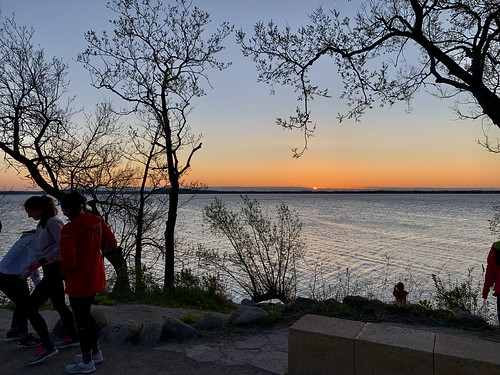
... had asked me if I'd take a picture of them — the kind of request I've always happily agreed to. And here I was being stand-offish, in the manner of a person with OCD because they wanted to hand me their phone. It's covid19world, and we're all OCD now, so I couldn't go along with that, and I knew they'd understand. Actually, they'd probably have understood in pre-covid19world and simply regarded me as a person with a disability to be treated with empathy.
But in pre-covid19world, covid19world, and post-covid19world, there is a solution to the problem of not wanting to touch the other person's phone. You don't need to refuse the lovely social opportunity to take someone's picture for them. It's AirDrop. Take a photograph on your own iPhone and AirDrop it to their phone. You just have to remember, and fortunately I did.
It was nice to encounter some young people, up for a 5:40 sunrise, experiencing our strange time with optimism. Nothing more optimistic than a sunrise.
The walk back from the vantage point had the sun at our back and the fading Flower Moon up ahead. I always love when Meade sings. He began "When the moon...." but it wasn't the "When the moon" song that I thought it was. There are at least 3 well-known songs that begin "When the moon...." Which is the first one that you think of? Two are optimistic but they take entirely different paths of optimism. The other one is sad. I don't know why the sad one is the one I thought of, such a sad old Depression-Era song...
Above: Everyone was in the mood for jazz, swing, and boogie-woogie at a concert held at the Olympia Country and Golf Club Friday night. The Jazz Senators were joined by a group called Somewhere in Time, above, who performed a tribute to The Andrew Sisters. The concert was open to the public.
With Mount Rainier and Budd Inlet as a stunning backdrop, the 17 member Jazz Senators gave a lively, open air, big band concert at the Olympia Country and Golf Club on Friday night. The concert was open to the public.
They were joined by a group called Somewhere in Time, who performed an energetic tribute to The Andrew Sisters. The three women, Melanie Bee, Alita DeLaCruz, and Gretchen Blair, made several costume changes throughout the show.
Bee and DeLaCruz have performed in several USO tours together, and Blair is a retired Army and Navy veteran who has performed for President George W. Bush.
Above: The Jazz Senators, led by band director Tracey D. Hooker, performed at the Olympia Country and Golf Club on Friday night.
“I’m completely delighted! This is my first time here - what great energy! What a beautiful night! I’ve been looking forward to this for weeks,” said band director Tracey D. Hooker during a break.
The Jazz Senators formed in 2005 as a backup for dentists performing at a benefit for the Olympia Union Gospel Mission. The group is comprised of active and retired military members, middle and high school band directors, and musical instructors.
Since that time, the group has performed at Rhythm & Rye in downtown Olympia, Panorama in Lacey, Music in the Park, and the Capitol Theater.
Above: Musician Gary Scott, lead alto saxophone player with the Jazz Senators.